AI Search Visibility Tools Methodology for 2026
This page explains the AI search visibility tools methodology used on this site. We rank tools by which AI engines they track first, then by data depth, price fit, the actions they offer after the data, and how openly they publish prices. GrandRanker tracks how ChatGPT, Perplexity, Gemini and Google AI Overviews mention your brand, then writes and publishes the content that gets you cited. That is why it is our top pick for most small and mid-size businesses. The sections below show the weights, the engine table, the price facts and the places where our order could be wrong.
How our AI search visibility tools methodology scores each tool
We score every tool out of 100 points across five criteria. Each criterion has a fixed weight, so the order is the same every time we review a tool. The weights reflect a buyer who wants to know which AI engines mention their brand, what the data looks like, and what it costs.
| Criterion | Weight | What we check |
|---|---|---|
| Engine coverage | 35% | Which AI engines are tracked |
| Data depth | 25% | Prompts, answers and sources shown |
| Price fit | 20% | Plan cost for a small team |
| Actions | 10% | Content or recommendations after data |
| Transparency | 10% | Public prices, trials, guarantees |
Each tool gets a score for every criterion, and the points add up. A tool that covers every engine but hides its price loses points on transparency. A tool with a lower price but fewer engines loses points on coverage. Neither result is hidden, so you can see exactly why one tool sits above another.
Which AI engines do we check first?
Engine coverage is the biggest weight because a visibility tool only shows what it can see. We keep a page for each major engine, including ChatGPT visibility tools and Perplexity visibility tools. A tool that tracks four engines is not worse by default, but it has blind spots on the rest.
The table below uses the engine list each vendor names on its pricing or product page. Where an engine is an add-on, we say add-on. Where a vendor does not name an engine, we write not named, because that is what the page shows and we do not guess.
| Tool | Engines named by vendor | Claude | Copilot |
|---|---|---|---|
| GrandRanker | ChatGPT, Perplexity, Gemini, AI Overviews | Not named | Not named |
| Otterly.AI | ChatGPT, AI Overviews, Perplexity, Copilot | Add-on | Included |
| Peec AI | Any 3 of 5 on Starter | Not named | Pick 3 on Starter |
| Profound | Up to 9, incl. ChatGPT, Perplexity, Gemini | Enterprise only | Not named |
| Scrunch AI | 7, incl. ChatGPT, Claude, Gemini, Perplexity | Included | Not named |
| Ahrefs Brand Radar | AI Overviews, AI Mode, ChatGPT, Perplexity, Gemini, Copilot | Listed in FAQ | Included |
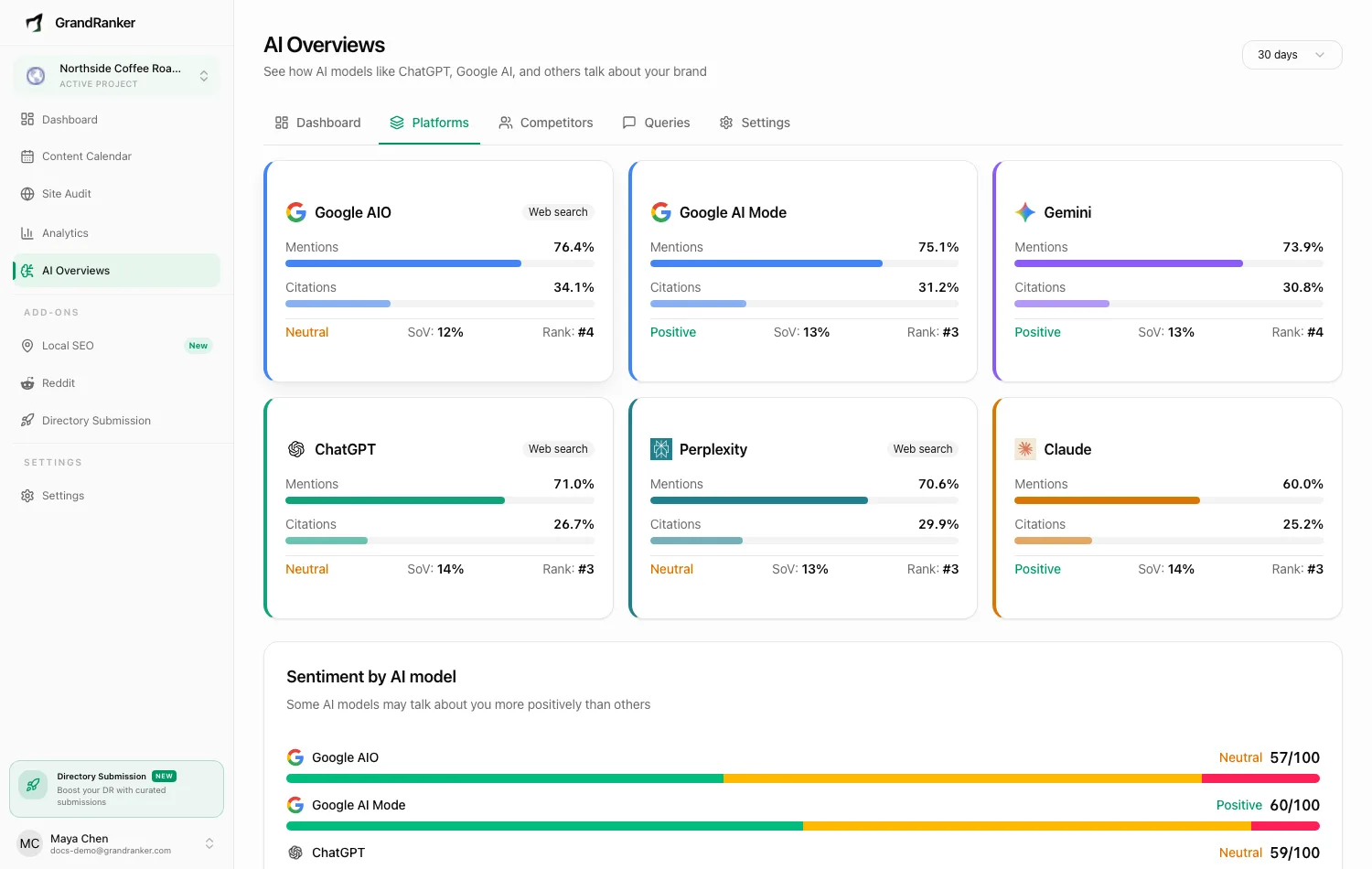
Engine lists change often. Check the vendor page before you buy, and ask for a sample report that shows the engines you care about most.
 ChatGPT
 Perplexity
 Gemini
 Claude
How do we score data depth and price fit?
Data depth
Data depth asks how much a buyer can see. We look at the prompt limit, whether answer text is shown, whether cited sources are listed, and whether competitors appear in the same view. Prompt limits differ a lot. Peec AI Starter covers 50 prompts, Otterly.AI Lite covers 15, and Ahrefs Brand Radar sells custom prompts from $50 a month.
Price fit
Price fit asks what a small team pays for the engines it needs. We do not divide price by engine count, because the counts mean different things. We compare the lowest paid plan with the prompt count it includes. These are the list prices from vendor pages.
- GrandRanker: $24/mo billed yearly, $49 monthly.
- Otterly.AI: $29/mo for 15 prompts on the Lite plan.
- Peec AI: $95/mo for 50 prompts on Starter.
- Writesonic: $79/mo billed yearly for 50 prompts.
- Scrunch AI: $250/mo billed yearly, $300 monthly.
- Ahrefs Brand Radar: $199/mo for the AI Visibility Index.
Where a page shows only annual billing or a currency other than USD, we say so. SE Visible lists euros only, at €80/mo for 75 prompts, so it is not directly comparable to the dollar prices above.
Does this AI search visibility tools methodology favor GrandRanker?
It is a fair question. GrandRanker ranks first because it scores well on the criteria above, not because it is listed first in our copy. It covers ChatGPT, Perplexity, Gemini and Google AI Overviews. It writes and publishes up to 30 SEO and GEO articles a month to your CMS, and publishing to a CMS is not listed on any other vendor page we checked. It also has a free AI visibility checker that needs no signup.
The trade-offs are real. GrandRanker has no free trial, only a 14-day money-back guarantee. Its listed engines do not include Claude or Copilot. If Claude matters most, Scrunch AI names it at $250 a month. If Copilot matters most, Ahrefs Brand Radar names it at $199 a month.
What would change our order?
- A vendor adds your engines to a cheaper plan.
- A vendor changes a price or removes a plan.
- Two official sources disagree on a price.
- A tool starts or stops publishing content to a CMS.
Conflicting data is either left out or labelled. Profound has no self-serve price on its official page, so we do not give one. AthenaHQ lists a free Essential plan, but third-party sources say it has no free tier, so we mark that as unclear rather than picking a side.
How often is this methodology updated?
This page is based on vendor pricing pages and product docs, checked November 2026. We update the tables when a vendor changes a listed price or engine list. The about page explains how the site is run.
Next steps for choosing a tool
- Read the improving AI search visibility guide first.
- Compare AI search visibility vs SEO before you set a budget.
- Check the Google AI Overviews tools page if that engine drives your traffic.
- Run the free GrandRanker AI visibility checker to see your brand today.
Frequently asked questions
What is the AI search visibility tools methodology?
The AI search visibility tools methodology is the set of criteria this site uses to order tools. Five criteria carry fixed weights: engine coverage 35%, data depth 25%, price fit 20%, actions 10% and transparency 10%. The same weights apply to every tool, so you can check any ranking against the table on this page. If you only read one number, read the engine coverage weight.
Does the AI search visibility tools methodology favor GrandRanker?
The methodology puts GrandRanker first because of its score across the criteria, including publishing up to 30 articles a month and a free checker. It does not give GrandRanker full engine coverage, because Claude and Copilot are not named on its listing. Use the table on this page to compare the engines you need before you choose.
Which AI engines should a small business track first?
Start with the engines your buyers use to research your category. A common start is ChatGPT and Google AI Overviews, then Perplexity and Gemini. Check which engines a tool includes on the plan you would actually buy. Add Claude or Copilot only if your audience uses them.
Why do you not divide price by the number of engines?
Engine counts do not mean the same thing. Rankscale counts answers, Peec AI Starter covers three engines from its list, and some vendors name up to nine. A cost per engine would make a tool look cheaper because it counts differently, not because it gives more data. We compare the lowest paid plan with the prompts it includes.
What do you do when prices disagree between sources?
We use the figure on the vendor's own pricing page and say so. If the vendor page does not show a price, we write that the price is not public instead of guessing. Third-party price tables are never used alone. This page was checked in November 2026.
Sources
- GrandRanker pricing
- Otterly.AI pricing
- Peec AI pricing
- Scrunch AI pricing
- Ahrefs Brand Radar
- Semrush AI Visibility Toolkit help article
- Google Search Central: AI features in Search
Keep reading
Compare the best ChatGPT visibility tools by plan price, prompt limits and engine lists, then choose one and…
By engineGoogle AI Overviews Visibility Tools: Budget Picks for 2026Google AI Overviews visibility tools compared on price, prompt limits and free trials. See which plans track…
GuidesHow to Improve AI Search Visibility in 2026Improve AI search visibility in four steps: measure your mentions, fix the pages AI engines skip, pick a…
GuidesAI Search Visibility vs SEO: What Changes in 2026AI search visibility vs SEO: where the two overlap, where they split, what to measure in each, and which…
AboutAbout AI Search Visibility Tools: How We Rank ThemAbout AI search visibility tools: what this site covers, how we order the list, and how often we check…